

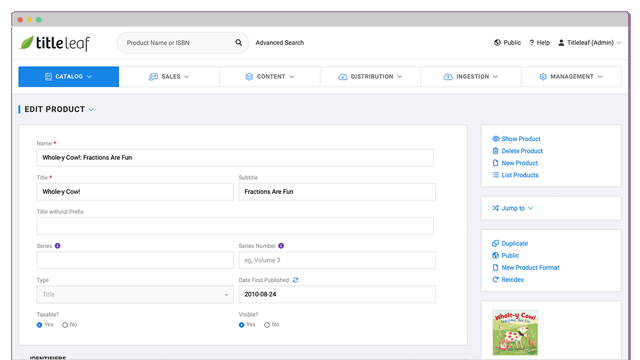
Harness the power of a relational database aligned with BISG standards to organize your product data and monitor the life-cycle of your assets.
ONIX Architecture
The TitleLeaf database is closely aligned to the BISG ONIX standard. This enables the publisher to more easily interact with ONIX standard-compliant wholesalers and distributors.
Shared Data Points
An individual title is available in numerous formats such as Hardcover, Paperback, Boardbook, and Epub. TitleLeaf allows those formats to share common data points.
Advanced Search
TitleLeaf empowers users to find the products they need and then act upon them in bulk. The advanced search mechanism is the hub of the TitleLeaf solution.
Book Taxonomies
TitleLeaf supports the gambit of taxonomies used to organize books. Dewey Decimal, BISAC, Thema and more are covered out-of-the box. You can also add your proprietary groupings for subjects, age ranges, grades, etc.
Ingestions
Create and update all metadata and files in bulk. TitleLeaf doesn't force you to manage your assets via its backend user interface. Instead, it frees your time by more closely connecting with your internal content management system.
Book Errata
Errors inevitably occur. Provide a common interface for customers and employees to submit and track errata. Having a central repository eases the process of reprinting.
Book Links
Use TitleLeaf to store bibliographic information related to other third-party sites. TitleLeaf also validates the site links on a regular basis.
Teaching Guides
Associate downloadable guides and activities to your books. The files are accessible from the product page or from the general teaching guides page.
Standards Alignment
Standards data such as the Common Core initiative can be integrated into TitleLeaf to facilitate alignment and communicate compliance.